

Discover Tira, the rare polka-dotted zebra photographed in Kenya’s Maasai Mara. Learn about its genetics, stripes, habitat, survival and where spotted zebras occur.
Polka-Dotted Zebra: Meet the Rare Spotted Zebra of the Maasai Mara
Imagine driving across the golden plains of Kenya’s Maasai Mara, surrounded by hundreds of familiar black-and-white zebras. Then, among the striped herd, you notice something that seems almost impossible, a tiny zebra with a dark coat covered in white polka dots.
That is exactly what happened in September 2019.
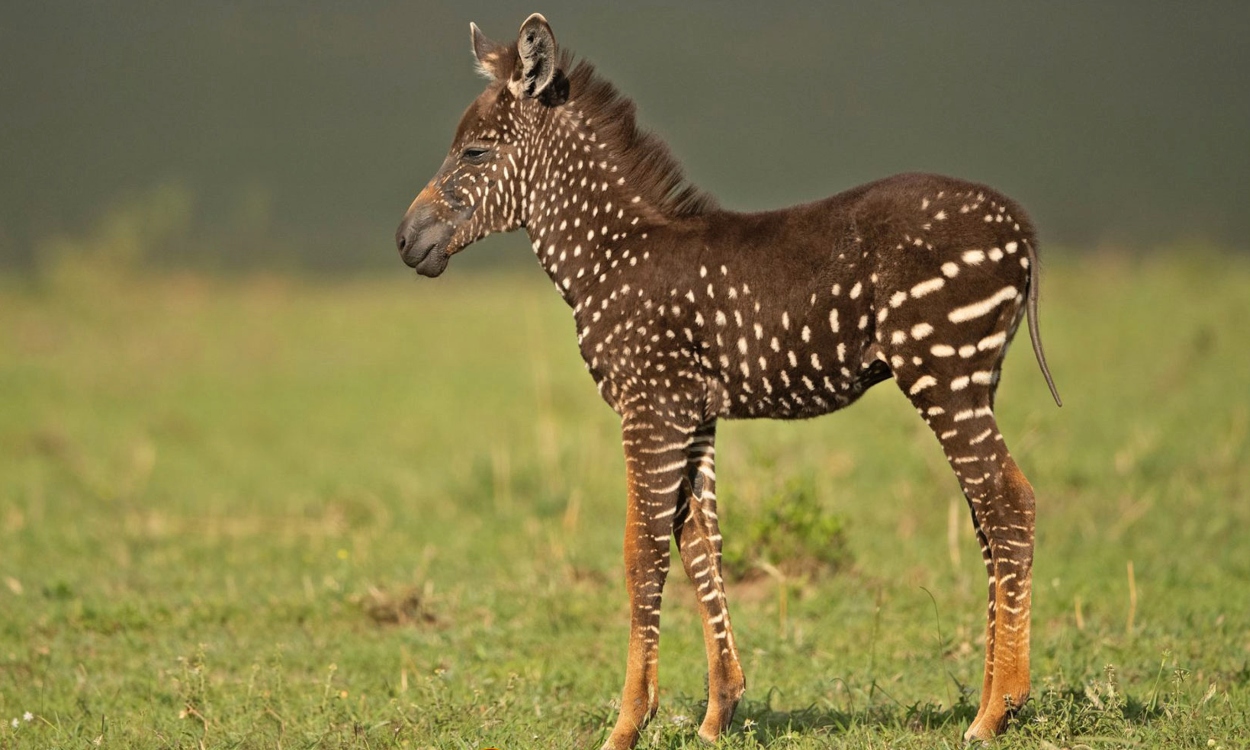
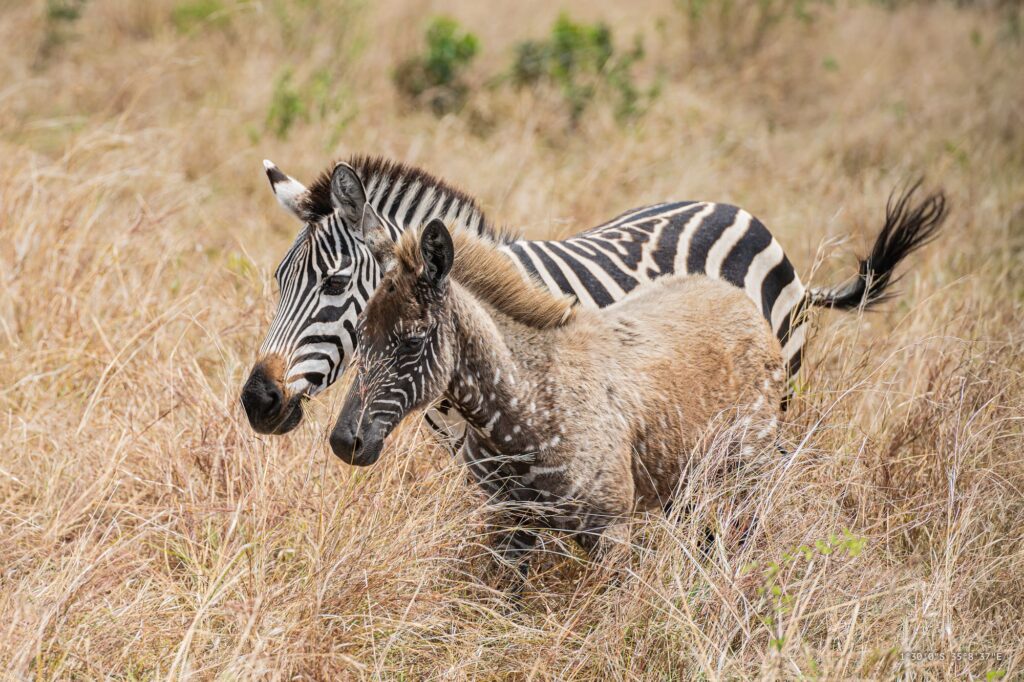
A young plains zebra was photographed in the Maasai Mara National Reserve with an extraordinary coat pattern unlike the familiar stripes of the animals around it. The foal was discovered by Maasai guide and photographer Antony Tira, after whom the animal was named. Photographer Frank Liu later captured some of the images that introduced the remarkable zebra to a worldwide audience.
The animal became known simply as Tira, the polka-dotted zebra.
But Tira was not a new species of zebra, nor was he a cross between a zebra and another animal. He was a plains zebra (Equus quagga) with an exceptionally rare pigmentation and stripe-pattern abnormality.
Scientists have discussed this type of unusual coloration using terms such as pseudomelanism, although geneticist Greg Barsh has noted that “spotted” or “partially spotted” may be more precise descriptions because pseudomelanism is not a clearly defined biological category in this context.
And that is what makes the story fascinating: Tira’s strange appearance offers scientists a glimpse into how one of Africa’s most recognizable animal patterns develops.
What Is a Polka-Dotted Zebra?
A polka-dotted zebra is not a separate zebra species. It is a zebra with an abnormal coat pattern in which the normal striping process is disrupted, producing spots, unusually concentrated dark areas, or other irregular patterns.
The famous Maasai Mara animal, Tira, was a plains zebra, the most widespread of the three living zebra species.
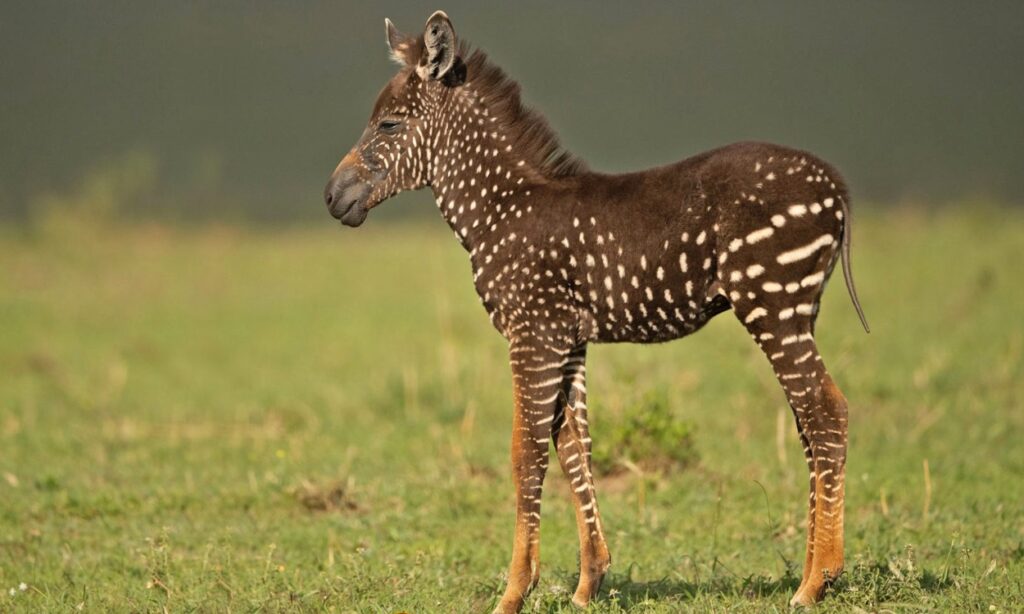
Instead of developing the conventional pattern of alternating dark and light stripes, much of Tira’s body was dark, with conspicuous white spots and a few incomplete stripes.
This distinction is important.
There are three living zebra species:
- Plains zebra (Equus quagga)
- Grevy’s zebra (Equus grevyi)
- Mountain zebra (Equus zebra)
Tira belonged to the first group.
So, if you ever hear someone describe him as a new species, that is incorrect. He was an extraordinary individual variation within a species that normally has stripes.
Where Was the Famous Polka-Dotted Zebra Found?
Tira was discovered in the Maasai Mara National Reserve in southwestern Kenya, close to the Mara River, in September 2019.
The Maasai Mara forms part of the larger Mara-Serengeti ecosystem, one of Africa’s most important wildlife landscapes. The ecosystem extends across the Kenya-Tanzania border and supports enormous populations of wildebeest, zebras, gazelles, predators and other wildlife.
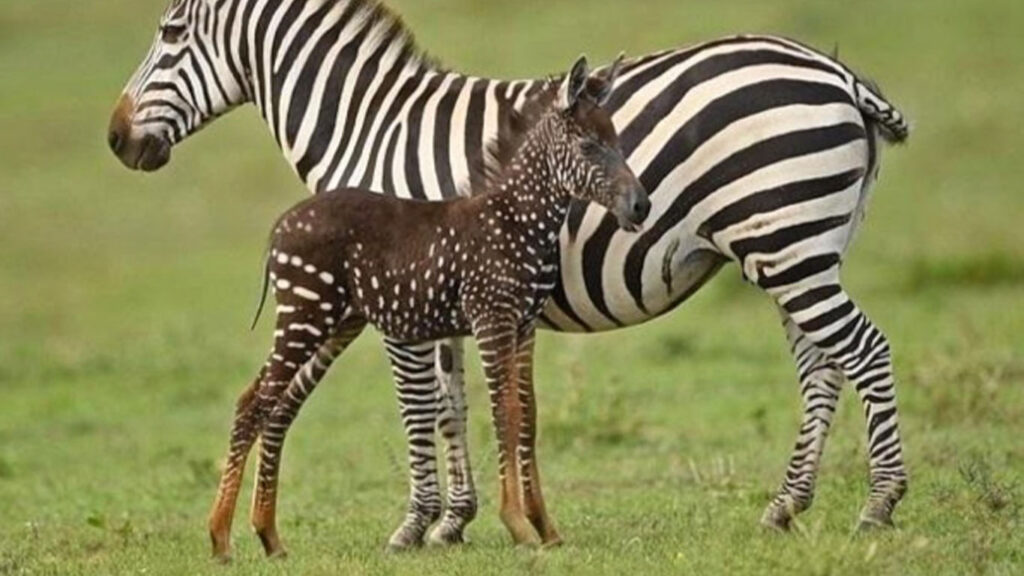
Tira was reportedly only about a week old when he was first photographed. He remained extremely close to his normally striped mother, just as a young zebra would ordinarily remain close to its mother for protection.
His unusual appearance immediately attracted attention from guides, photographers, researchers and visitors.
But there is an important part of Tira’s story that is sometimes lost in viral posts.
Why Did Tira Have Polka Dots Instead of Stripes?
This is where the story becomes particularly interesting.
Zebra coloration begins with melanocytes, specialized pigment-producing cells involved in producing melanin. The dark hairs of a normal zebra contain melanin, while the lighter hairs lack the dark pigmentation.
Researchers studying Tira proposed that the problem was not necessarily that he lacked melanocytes. Instead, the cells may have failed to establish the normal pattern that produces the characteristic zebra stripes.
In other words, the zebra’s biological “stripe-making system” appears to have gone off-script.
Rather than producing regular bands, pigment distribution resulted in an unusual spotted pattern.
Scientists have also documented other abnormalities in zebra coat patterns, including melanistic individuals with unusually concentrated dark striping and spotted animals with disrupted stripes.
So Tira was not simply a “black zebra with white paint spots.”
His appearance was the result of a rare biological variation in how pigmentation and pattern formation developed.
Are Polka-Dotted Zebras Rare?
Extremely.
Spotted and unusually patterned zebras have been documented before, including examples in Botswana’s Okavango Delta and elsewhere in Africa. Researchers have also documented other forms of abnormal zebra pigmentation and striping.
However, these animals are sufficiently uncommon that a polka-dotted zebra appearing in the Maasai Mara became an international wildlife story almost immediately.
Researchers have suggested that unusual coat patterns may be associated with genetic factors, and studies of plains zebra populations have raised questions about the relationship between population structure, genetic diversity, inbreeding and stripe-pattern abnormalities.
That does not mean that every unusual zebra is the result of inbreeding. Rather, genetic research suggests that population structure and reduced genetic diversity can be relevant factors worth investigating.
Why Do Zebras Have Stripes in the First Place?
For more than a century, scientists have debated why zebras evolved their extraordinary black-and-white coats.
Several hypotheses have been proposed, including:
- Camouflage
- Predator confusion
- Social recognition
- Temperature regulation
- Protection against biting flies
Modern research has provided particularly strong evidence for the biting-fly hypothesis.
A landmark study published in Nature Communications found strong associations between zebra striping and the geographic distribution of biting flies, particularly tabanids, while finding less consistent support for camouflage, predator avoidance, heat management and social-interaction explanations.
More recent scientific reviews, however, emphasize that the evolutionary story may be more complicated. A 2025 review concluded that deterring biting flies currently has the strongest empirical support, while noting that no single hypothesis completely explains every aspect of zebra striping.
That is an important distinction for a scientifically responsible article:
We have strong evidence for some functions of zebra stripes, but scientists are still investigating exactly why the pattern evolved in the particular form we see today.
Could Tira’s Missing Stripes Have Made Survival More Difficult?
Potentially, yes. A zebra’s survival depends on its ability to remain with the herd, avoid predators, find food and water, and reproduce. Researchers raised concerns that an unusually patterned individual could stand out from a group of normally striped zebras, potentially making it easier for predators to identify.
Zebras gain important protection from living in groups. Large herds can make it harder for predators to isolate a single individual, creating a form of predator confusion and dilution effect.
An animal that visually differs dramatically from the rest of the herd may therefore face a potential disadvantage.
There is another possible concern.
If zebra stripes help reduce attacks by biting flies, an animal lacking the normal pattern could potentially lose some of that protection. Experimental research has shown that biting flies are less likely to land on striped surfaces, providing evidence for an anti-fly function of zebra striping.
However, there is no reliable evidence that Tira specifically died because of his unusual coat.
His ultimate fate remains undocumented.
Do Other Zebras Accept Spotted Zebras?
There is no evidence that zebras automatically reject individuals because their coats look different.
Research and observations of abnormally patterned plains zebras suggest that unusual coloration does not necessarily prevent an individual from forming normal social relationships within a herd.
Tira himself was photographed moving closely alongside his mother and other zebras during his early days in the Maasai Mara.
For a newborn zebra, staying close to its mother is critical. The mother provides protection, guidance and access to the herd, regardless of whether her offspring looks like every other zebra around it.
Can You See a Polka-Dotted Zebra on Safari in Kenya?
This is where travelers need to be realistic.
You should not book a safari expecting to see Tira.
Tira was discovered in 2019, and his current whereabouts have not been reliably established. There is no evidence that he remains a regularly sighted resident of the Maasai Mara.
However, the Maasai Mara remains one of Kenya’s best destinations for seeing plains zebras in their natural habitat.
During the Great Migration, enormous numbers of zebras move through the Mara-Serengeti ecosystem alongside wildebeest and other grazing animals. Watching thousands of normally striped zebras spread across the savannah provides an extraordinary perspective on just how unusual Tira’s appearance really was.
And occasionally, nature produces another surprise.
Experience Kenya’s Wildlife With Bobu Africa
The story of Tira is a reminder that every safari can reveal something you’ve never seen before.
At Bobu Africa, we go beyond simply taking travelers into Kenya’s famous parks. Our safari experiences are designed around wildlife behavior, seasonal movements and the individual interests of each guest, from the Great Migration and Big Five encounters to birding, photography and the smaller stories hidden within the ecosystem.
The Maasai Mara may be famous for its lions, cheetahs and migrating wildebeest, but sometimes the most unforgettable encounter is a zebra that simply refuses to follow the pattern.
Ready to discover the extraordinary side of Kenya’s wilderness? Let Bobu Africa design your next safari.