

The best time to see the Great Migration each month
There is no single time of year to see the Great Migration since it is an eternal annual cycle from place to place, year in and year out. However, depending on either the aspect of the Great Migration you want to witness (such as river crossings), or the time of year that you prefer to travel, your safari can be tailored to give you the best chance of seeing what you desire. The Great Migration can be summarised in this way as having four seasons.
Alternatively, you can learn more about when to travel via through the below month-by-month breakdown of the Great Migration.
Whether the great herds are calving in the south or on the move north in search of greener pastures – and then back again – there is a huge variety of astounding scenes unfolding before you.
How The Story Unfolds Each Year
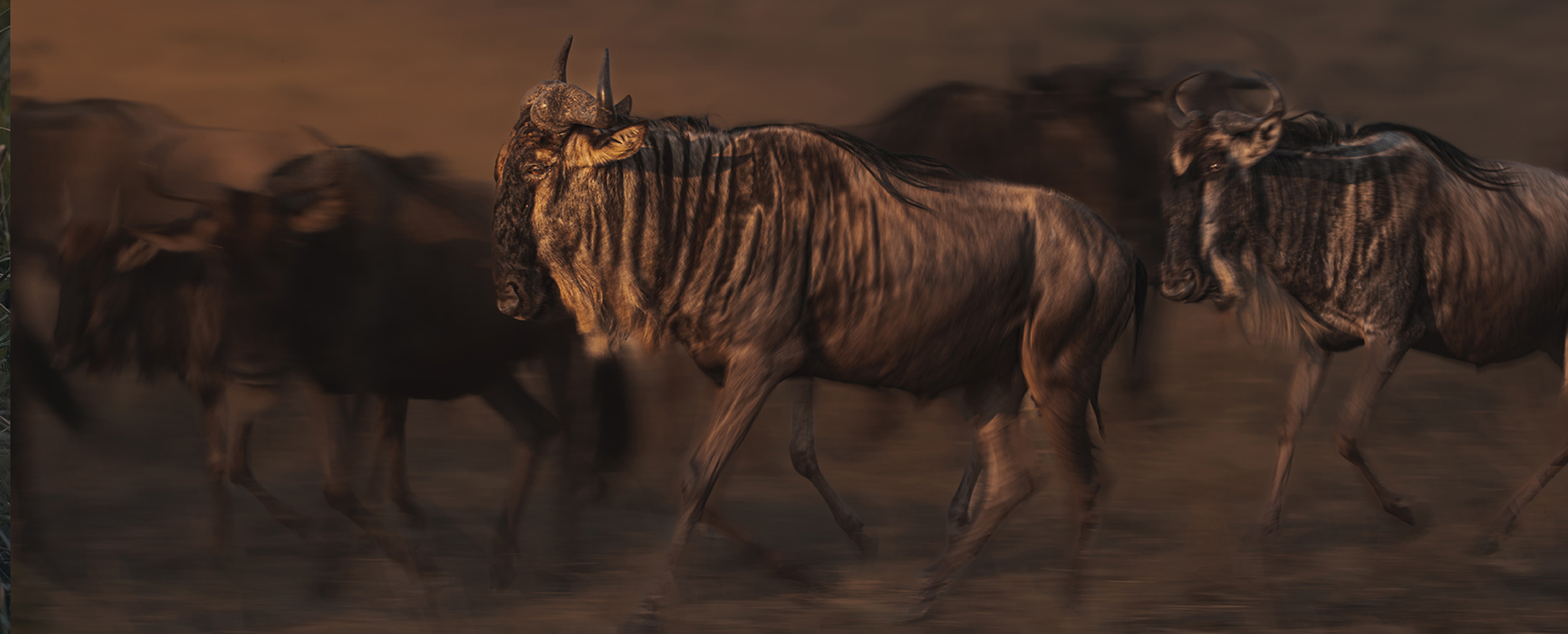
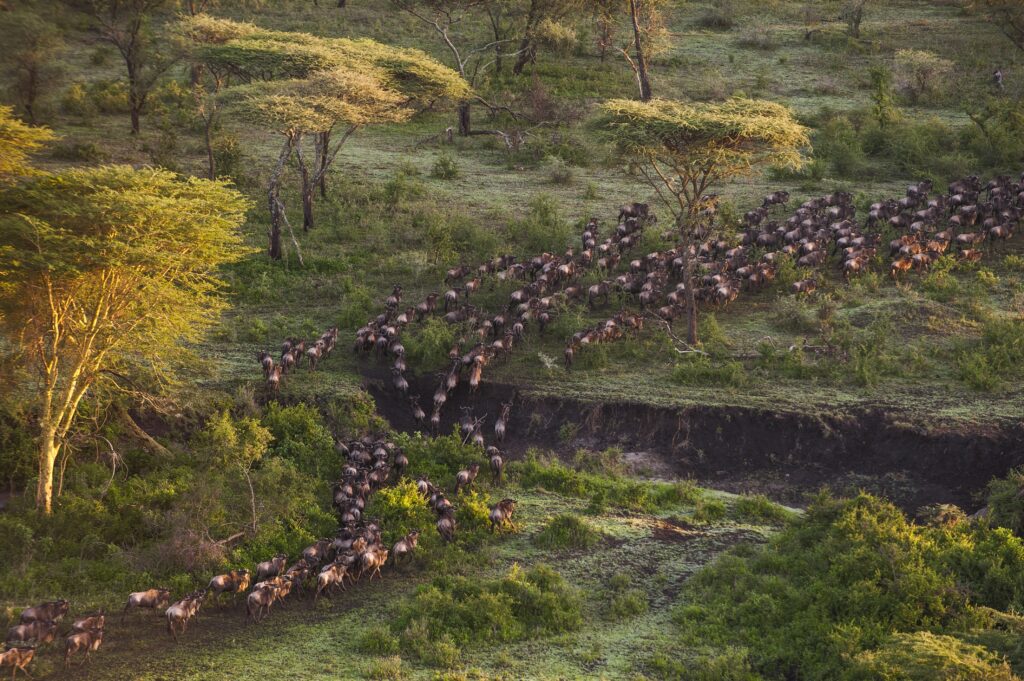
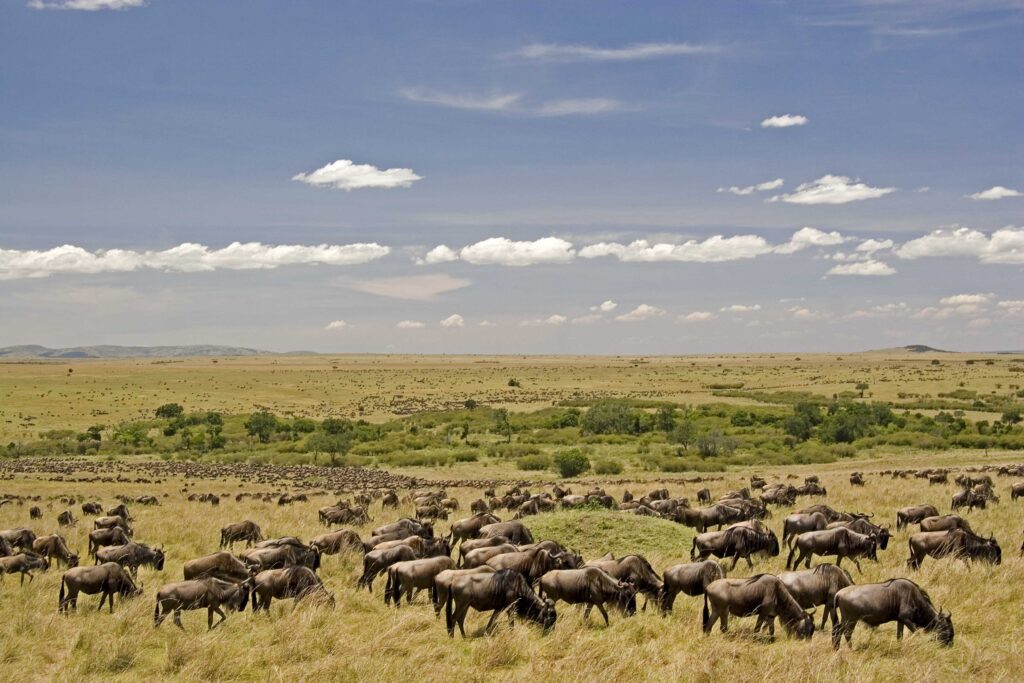
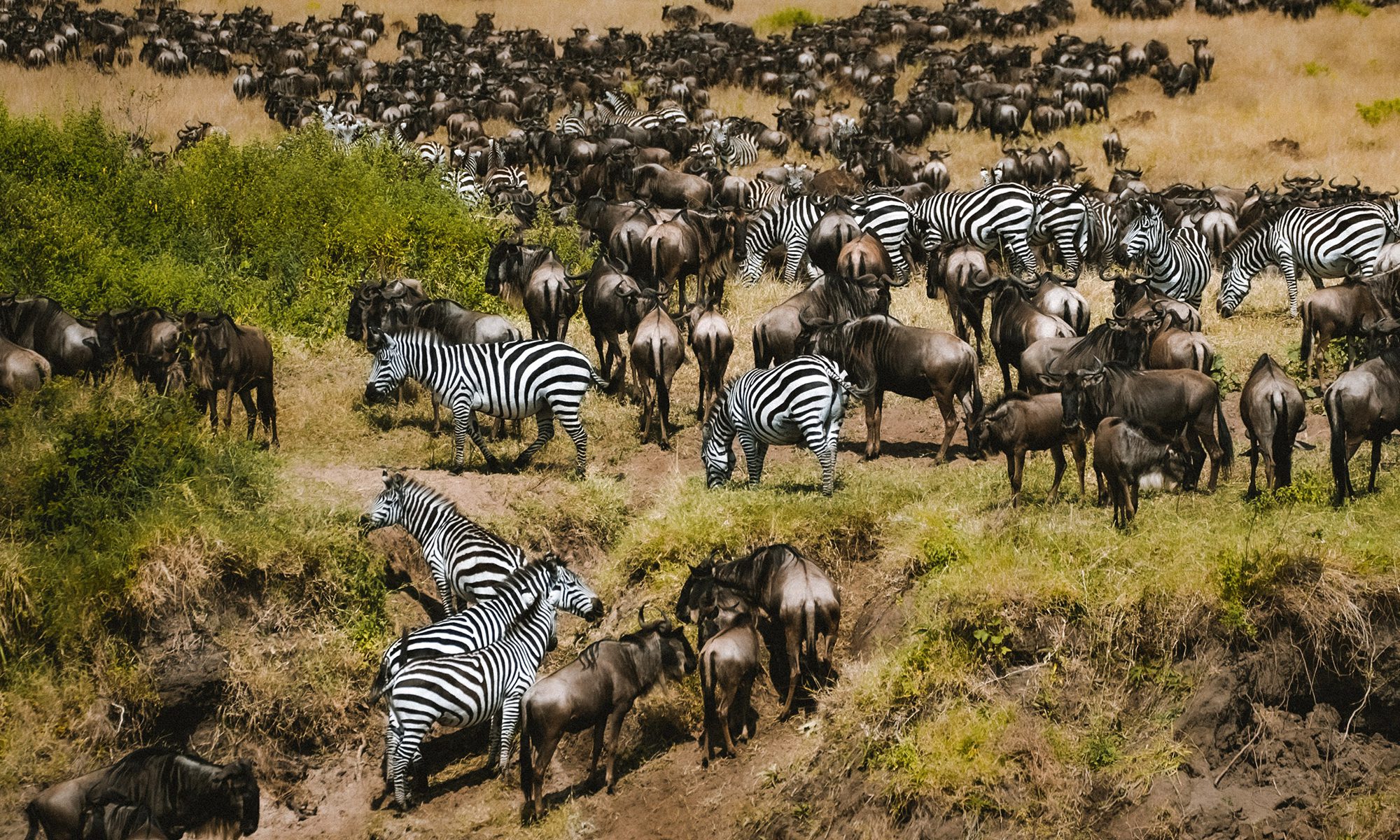
The Great Migration is the largest herd movement of animals on the planet. In fact, with up to 1,000 animals per km², the great columns of wildebeest can be seen from space.
The numbers are astonishing: over 1.2 million wildebeest and 300,000 zebra along with topi and other gazelle move in a constant cycle through the Serengeti-Mara ecosystem in search of nutritious grass and water. Guided by survival instinct, each wildebeest will cover 800 to 1,000km on its individual journey along age-old migration routes. Hungry predators including lion, leopard, cheetah, hyena, wild dog and crocs make sure only the strongest survive in this natural spectacle also known as ‘the greatest show on Earth.’
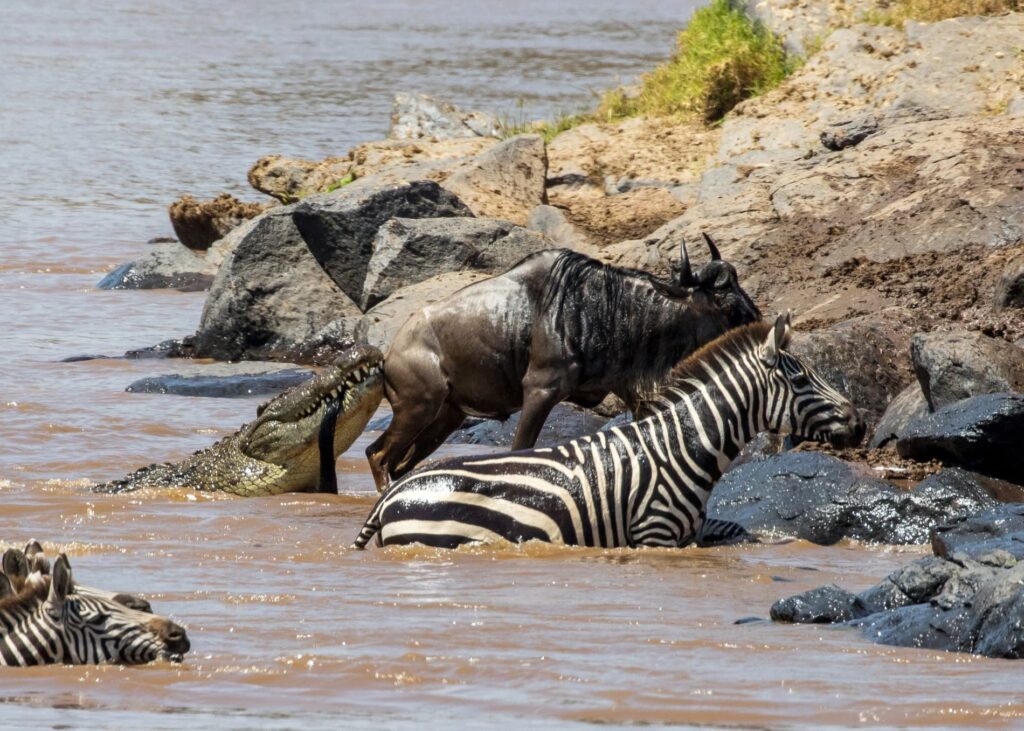
The circuit takes the animals from the Ngorongoro Conservation Area (although not in the Crater itself) in the south of the Serengeti in Tanzania, up through the Serengeti and across into the Maasai Mara in Kenya and back again. The journey is beset with danger: young calves are snatched by predators, the slow are brought down by prides of lion, brave beasts break legs on steep river slopes, crocodiles take their share of the stragglers, and the weak and exhausted drown.
The three main groups of migrant grazers each have distinct feeding habits that help maintain balance across the plains. Zebras are the first to arrive, cropping the tallest, coarser grasses. Wildebeest follow, feeding on the shorter, fresher shoots that sprout afterward. Finally, Thomson’s gazelles move in, nibbling the remaining tender grasses and herbs close to the ground. This grazing succession means that each species tends to stick with its own kind, with only limited overlap in their ranges as they move together along the migration route.
How The Story Unfolds Each Year
The Great Migration is the largest herd movement of animals on the planet. In fact, with up to 1,000 animals per km², the great columns of wildebeest can be seen from space.
The numbers are astonishing: over 1.2 million wildebeest and 300,000 zebra along with topi and other gazelle move in a constant cycle through the Serengeti-Mara ecosystem in search of nutritious grass and water. Guided by survival instinct, each wildebeest will cover 800 to 1,000km on its individual journey along age-old migration routes. Hungry predators including lion, leopard, cheetah, hyena, wild dog and crocs make sure only the strongest survive in this natural spectacle also known as ‘the greatest show on Earth.’
The circuit takes the animals from the Ngorongoro Conservation Area (although not in the Crater itself) in the south of the Serengeti in Tanzania, up through the Serengeti and across into the Maasai Mara in Kenya and back again. The journey is beset with danger: young calves are snatched by predators, the slow are brought down by prides of lion, brave beasts break legs on steep river slopes, crocodiles take their share of the stragglers, and the weak and exhausted drown.
The three main groups of migrant grazers each have distinct feeding habits that help maintain balance across the plains. Zebras are the first to arrive, cropping the tallest, coarser grasses. Wildebeest follow, feeding on the shorter, fresher shoots that sprout afterward. Finally, Thomson’s gazelles move in, nibbling the remaining tender grasses and herbs close to the ground. This grazing succession means that each species tends to stick with its own kind, with only limited overlap in their ranges as they move together along the migration route.
When and Where to Witness the Great Migration
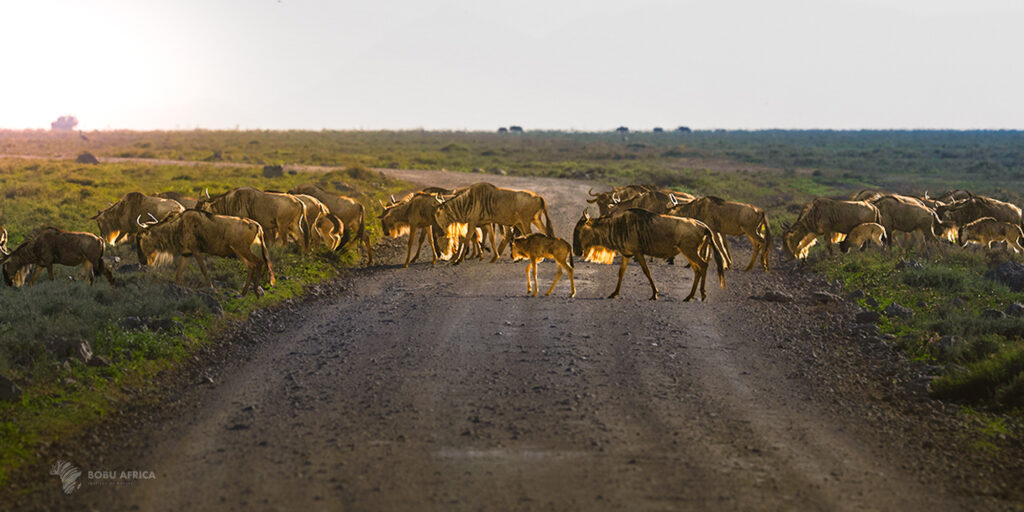
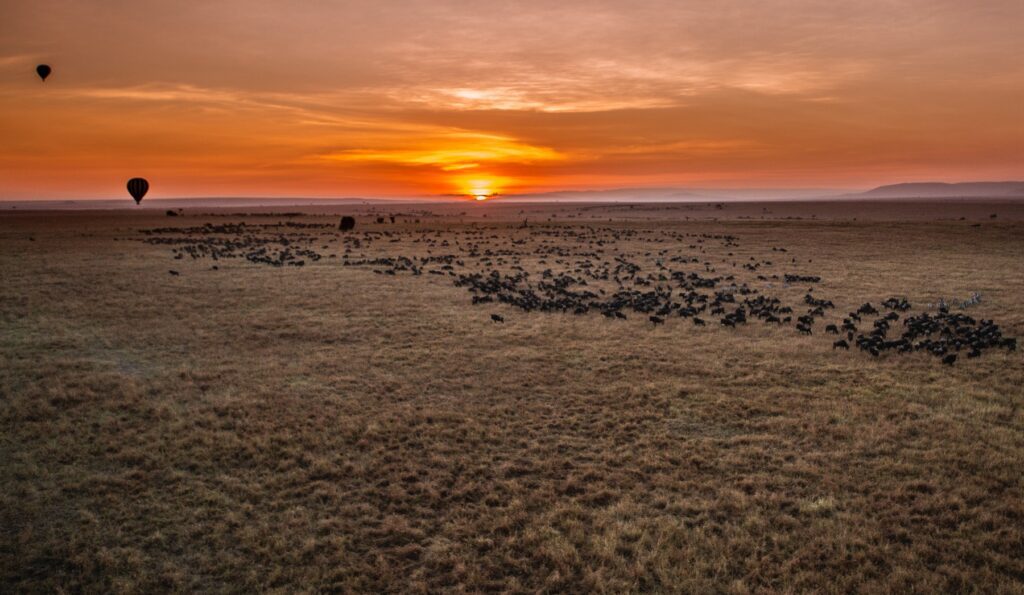
The migration route begins in Tanzania’s Ngorongoro Conservation Area, moves northward through the Serengeti, crosses into Kenya’s Maasai Mara, and then loops back again. While the Great Wildebeest Migration is a continuous, year-round journey, its rhythm is dictated entirely by the rains, which have become increasingly unpredictable. The general month-by-month pattern is therefore only a guideline, as the seasons can be early or late, throwing the entire wildebeest calendar out of sync. This is why it is essential to plan for as much time on safari as possible. The best time to see the wildebeest migration is often linked to two key events: the dramatic Mara River crossings, which typically occur between late July and early September, and the calving season in the southern Serengeti, from late December to mid-March, when thousands of young wildebeest are born in just a few weeks.
Where the seasons overlap well
The most useful overlap between Great Migration interest and birding quality often comes in the green season and the shoulder months around it, especially from late November through March in parts of Tanzania, and in some cases into early April depending on route and weather.
This is why the southern Serengeti and Ndutu, Tanzania, can be so satisfying for travelers who want both mammal drama and rich birding texture. Calving season gives the mammal story urgency, while greener conditions, active bird life, and migrant presence often improve the birding side of the experience.
In field terms, this period is less about classic river-crossing drama and more about building an elegant mixed safari. You trade some of the headline migration imagery for a more layered wildlife experience.
At Bobu Africa, we usually treat December to March as the practical baseline for travelers who want a better balance between migration interest and birding richness, especially if photography matters beyond one iconic herd scene.
Where the seasons start to diverge
The clearest divergence often comes in the classic northern Great Migration months, especially around July to September and sometimes into October. These months can be excellent for herd movement, Mara river drama, and open-country mammal photography. But they are not always the most rewarding period for birders who want East Africa at its richest seasonal variety.
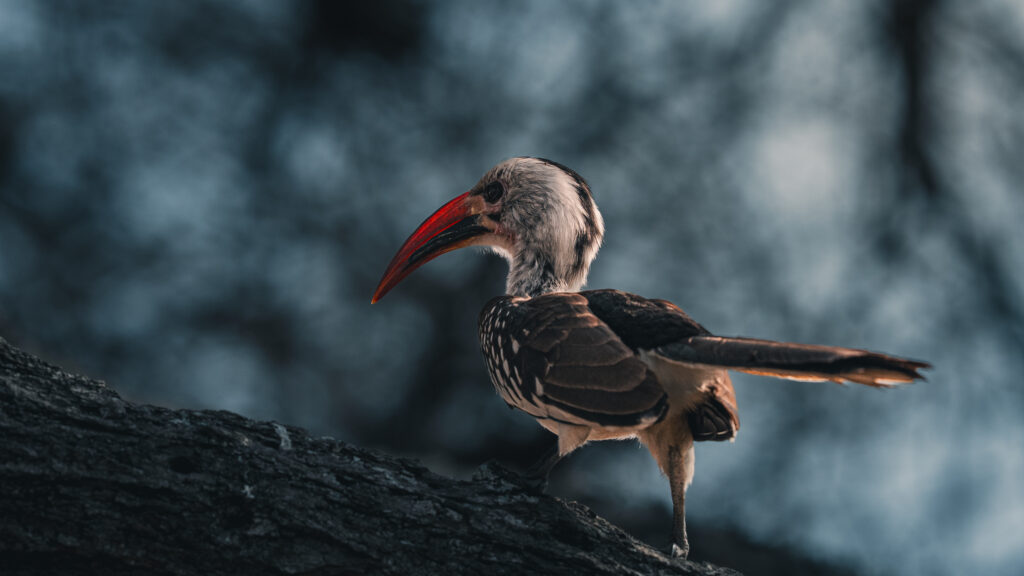
That does not mean birding is poor. Far from it. Open-country birding in Maasai Mara, Kenya, Serengeti, Tanzania, Samburu, Kenya, or Tarangire, Tanzania, can still be highly satisfying. Raptors, rollers, bustards, hornbills, shrikes, and many savanna species continue to deliver strongly.
The difference is one of breadth. In many years, the wetter-season freshness, migrant presence, and all-round ecological animation that support peak birding diversity are not at their strongest in the classic Migration river-crossing period.
In field terms, Great Migration peak usually means higher mammal drama and cleaner safari logistics, while broad birding peak usually means greater avian variety and a richer habitat mood.
Which season is better for wildlife photographers
This depends on what kind of photography you care about.
If your dream is river crossings, giant herd movement, dust, pressure, and the graphic force of East Africa at large mammal scale, then the northern Great Migration season is the stronger answer. Maasai Mara, Kenya, and northern Serengeti, Tanzania, are built for that emotional register.
If your portfolio goal is broader wildlife variety, richer backgrounds, bird activity, greener frames, and more ecological texture, the birding-led seasons often produce a more balanced result. Ndutu, Tanzania, in the green season is especially strong here because the mammal story is still powerful while the birding and atmosphere feel more layered.
For photographers, the real trade-off is simple. The Great Migration peak gives bigger headline moments. Birding-led timing often gives wider portfolio consistency.
Which season is better for birders
If birds are the central goal, the broader answer usually leans toward October through April rather than the classic river-crossing window alone. This is especially true for travelers who want migrant species, fresher wetlands, more active mixed habitats, and a route that extends beyond one mammal-famous ecosystem.
In practical planning terms, birders often benefit from combining open savanna with Rift lakes, dry country, or other habitat changes. Maasai Mara, Kenya, and Serengeti, Tanzania, can still be included, but they usually perform best as one component rather than the whole answer.
At Bobu Africa, we usually treat 10 to 14 nights as the practical baseline for travelers who want both good birding and some Great Migration value without flattening the route into too much transit.
Which season is better for first-time safari travelers
For first-time safari travelers, the answer depends on emotional priority.
If the dream is to witness one of the world’s great mammal spectacles, then build honestly around the Great Migration. That story has a clarity and force that needs no apology.
If the dream is a more rounded safari with birds, mammals, richer seasonal mood, and a little less pressure on one headline moment, then a greener-season route may actually be the better first trip. Many travelers assume the most advertised season is automatically the best introduction. Sometimes a more layered season gives a more complete feeling of East Africa.
A practical way to choose
A useful planning rule looks like this:
- Choose July to September, sometimes into October, if river crossings, herd scale, and mammal drama matter most
- Choose December to March if you want calving-season migration interest combined with stronger birding texture
- Choose October to November if you want migration-adjacent birding, migrant arrivals, fresher habitats, and more seasonal nuance
- Avoid trying to maximize both classic crossing drama and a broad multi-habitat birding route in too few nights
That last point is important. One safari can include both themes, but only if the route accepts trade-offs rather than pretending they do not exist.
The best compromise routes
For travelers who want both, the best compromise is usually not to chase the most famous crossing week and then bolt on birding as an afterthought. The better solution is often to choose a season and geography where the two stories genuinely support each other.
The southern Serengeti and Ndutu, Tanzania, from roughly December through March are especially strong for this. So are some shoulder-season East Africa routes that combine one major savanna ecosystem with a wetland or dry-country extension.
In the Mara ecosystem, location matters more than room glamour when field hours are limited. That same principle applies to mixed-interest routes across East Africa. The most elegant safari is usually the one that chooses fewer, stronger habitat blocks and lets each one work properly.
So when should you actually go
If the Great Migration is the emotional center of the trip, go when the relevant phase of the herd cycle is strongest and accept that birding may be good rather than peak. If birding is the deeper purpose of the trip, go during the broader October to April bird-rich period and use migration as one part of the story, not the whole one.
If you want the smartest compromise, the green season and calving period in southern Serengeti and Ndutu often offer one of the most balanced answers in East Africa. It may not give you the most famous river-crossing image, but it often gives a more layered safari overall.
FAQ
Is the best time for the Great Migration also the best time for birding
Not always. The classic Great Migration peak, especially for river-crossing drama, often favors mammal spectacle more than broad birding variety. Birding usually has a wider and more habitat-dependent peak, especially from October through April.
What is the best compromise month for both the Great Migration and birding
For many travelers, January to March is one of the strongest compromise periods, especially in the southern Serengeti and Ndutu, Tanzania. This period combines calving-season migration interest with greener habitats, active bird life, and a more layered overall safari.
Should birders skip the Great Migration season
No. The Great Migration season can still be rewarding for birders, especially in open-country ecosystems. The main question is whether birds are the core goal or a strong supporting element in a mammal-led safari.
How many nights do I need if I want both migration and birding
Ten to 14 nights is a practical baseline for doing both with some honesty. Shorter trips can still work, but they usually require a tighter focus and clearer trade-offs.
A more field-smart way to shape the season
If you want to plan an East Africa safari around the right balance of Great Migration timing, birding value, photography goals, and realistic route logic, Bobu Africa can help shape it as a professional creative journey rather than a generic seasonal checklist. The goal is not to force two peak seasons into one story. It is to choose the version of East Africa that fits your eye, your priorities, and the kind of safari you want to remember.
FAQ
Q: Is the best time for the Great Migration also the best time for birding
A: Not always. The classic Great Migration peak, especially for river-crossing drama, often favors mammal spectacle more than broad birding variety. Birding usually has a wider and more habitat-dependent peak, especially from October through April.
Q: What is the best compromise month for both the Great Migration and birding
A: For many travelers, January to March is one of the strongest compromise periods, especially in the southern Serengeti and Ndutu, Tanzania. This period combines calving-season migration interest with greener habitats, active bird life, and a more layered overall safari.
Plan Your Journey
If you want, Bobu Africa can help turn this timing choice into a field-smart East Africa route shaped around Migration phase, birding priorities, photography goals, and the kind of seasonal experience you actually want.